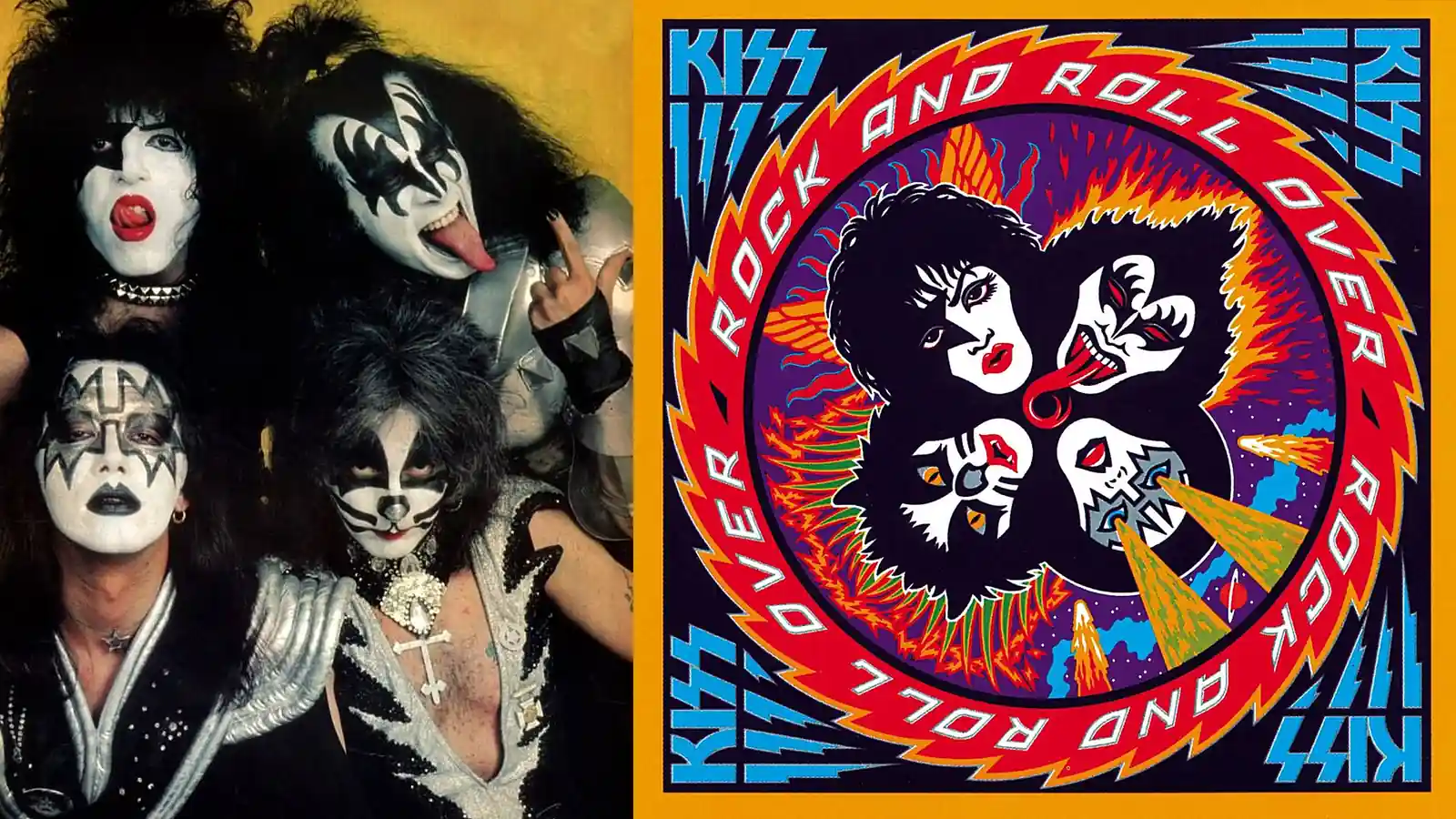


On November 11, 1976, Kiss released Rock and Roll Over, their fifth studio album: the record where they decided to sound like their live show again, raw and direct, opening with a first punch called “I Want You” that still sounds like a clenched fist.
Less than eight months had passed since Destroyer, Bob Ezrin’s meticulous record that gave them “Beth” and the doors of radio. With the band now a phenomenon, the pressure to keep the momentum was huge, and the answer was a hard turn: no more orchestras and effects, back to guitars, bass, drums and songs built to be played loud. To get there they called Eddie Kramer again, the engineer who years earlier had captured the studio sound of Jimi Hendrix and who had known the band since their debut album.
What can we hear?
An empty theater in Nanuet
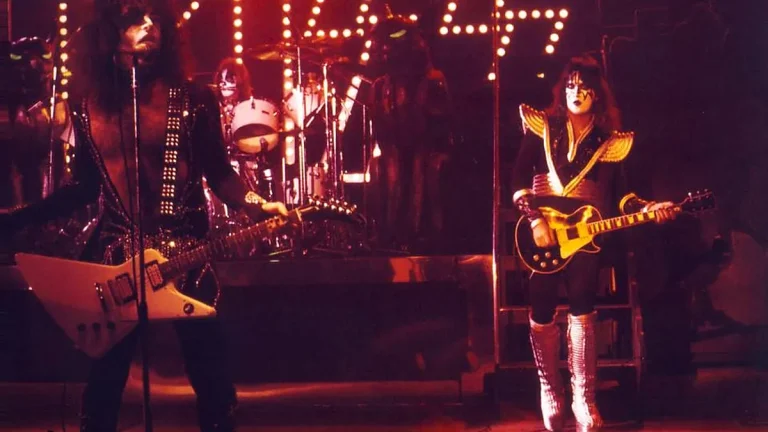
Rock and Roll Over was recorded between September and October 1976 at the Star Theatre in Nanuet, New York, a theater-in-the-round holding about 2,000 people that had gone under as a business. According to Paul Stanley, it was Kramer who found the place. There they set up their amps in a huge empty space, looking for wood, high ceilings and moving air, the echo of a concert without an audience. Stanley himself described the album as a 180-degree turn to get back to how the band sounded live.
There is a legendary detail: to get a big, roomy drum sound, Peter Criss recorded his parts in a bathroom, connected to the rest of the band through a video link. It is one of the most repeated stories about the record and helps explain that dry, wide, direct sound. Kramer produced and engineered almost alone, with Corky Stasiak as his assistant and no layers of production in between. The result feels close to a live album, without the varnish of Destroyer.
Destroyer: boot camp
Rock and Roll Over arrived at the band’s highest point. Alive! (1975), the live album that catapulted them, had turned them into a phenomenon, and Destroyer (March 1976) confirmed they could go even further. But that leap came at a price. Destroyer was produced by Bob Ezrin, so demanding that Paul Stanley called the sessions a “brutal boot camp.” Ezrin wore a whistle around his neck, treated the musicians as “campers” and, as Stanley told it in his memoir Face the Music, made it clear who was in charge and that they knew nothing. He even halted the sessions to give them music theory lessons.
The pressure showed in each of them. The story goes that Peter Criss struggled to keep a steady tempo and that Ezrin kept time by hitting an object, a briefcase or a box depending on the version, which enraged him. With Ace Frehley the friction was even more visible: he showed up late or not at all, Stanley has spoken about how hard it was to count on him, and Ace himself admitted that Ezrin was not an easy producer but that he was not an easy guitarist either. Ezrin then called in Dick Wagner, guitarist in Alice Cooper’s band, who recorded the solo on “Sweet Pain” and the acoustic guitar on “Beth.” It was one of the first times an outsider replaced a Kiss member on a record.
The result was huge: Destroyer became their first platinum studio album and gave them “Beth,” with orchestra, children’s choir and sound effects. But the demands were almost military, and our reading is that at times they asked for more than each of them could give. Simmons recalled in his autobiography that Ace and Peter were pushing to get back to basics: four musicians, no arrangements, no ballads and nobody telling them how to play. Rock and Roll Over was that return to the roots, to what Kiss really wanted to be. To get there they went back to Eddie Kramer, who had already co-produced Alive! and had produced and recorded artists such as Jimi Hendrix. From Ezrin’s whistle to an empty theater, from the orchestra to a drum kit in a bathroom, from boot-camp discipline to the freedom of sounding like a live band.
The context: seventies hard rock
In the mid-seventies hard rock was expanding fast: Led Zeppelin with Houses of the Holy had already shown how far the genre could go, and months later Judas Priest with Sin After Sin would push metal into new territory. Kiss did not invent a new formula: they took the straight riff, the sing-along chorus and the spectacle, and left it at its most muscular. That is why many consider it one of the heaviest records in their catalog, although critics never fully agreed. AllMusic sees it as one of their most consistent works and Pitchfork finds it punchier than Destroyer, while Martin Popoff called it the band’s most childish album. Both sides of the coin are part of its charm.
The cover, a circular illustration by Michael Doret with the four faces spinning among flames and comets, is one of the most recognizable in Kiss history.
The songs you cannot miss
I Want You: the opening punch
Opening with “I Want You” was a statement of intent. It is one of the hardest songs on the album and in the whole band’s catalog: thick riff, firm pulse and Stanley’s voice out front, no ornaments. There is no friendly intro; the record goes straight for the throat. It makes clear that this time they were not here to make orchestral ballads.
Calling Dr. Love, Take Me and the heart of the record
“Take Me” keeps the pace with a hungry guitar, and “Calling Dr. Love” became a staple of the band’s live shows. Gene Simmons wrote it in a Holiday Inn room in Evansville, Indiana, and the title comes from a hospital intercom announcement in a Three Stooges film. “Ladies Room,” also by Simmons, and “Love ’Em and Leave ’Em” continue with that dirty, double-meaning rock, and “Baby Driver,” co-written by Peter Criss with Stan Penridge, closes side one. “Mr. Speed” and “Makin’ Love” are Stanley in pure rock and roll mode, and “See You in Your Dreams” brings Simmons’s darkest color.
Hard Luck Woman: the song meant for Rod Stewart
Here is the most curious story on the album, with one important nuance: the song was not written by Peter Criss but by Paul Stanley. He composed it with Rod Stewart in mind, inspired by the style of “Maggie May,” and played it on a twelve-string acoustic guitar. But after the success of “Beth,” sung by Criss, the band decided to keep it. Criss asked to sing it himself, Simmons and Kramer also insisted it stay with Kiss, and his raspy voice ended up sounding so much like Stewart that when it hit the radio many people thought it was him. It was the album’s first single, reached No. 15 on the Billboard Hot 100, and years later Garth Brooks recorded it for a Kiss tribute. Rod Stewart, for the record, never recorded it.
Each member’s contribution and a lasting legacy
What each member brought
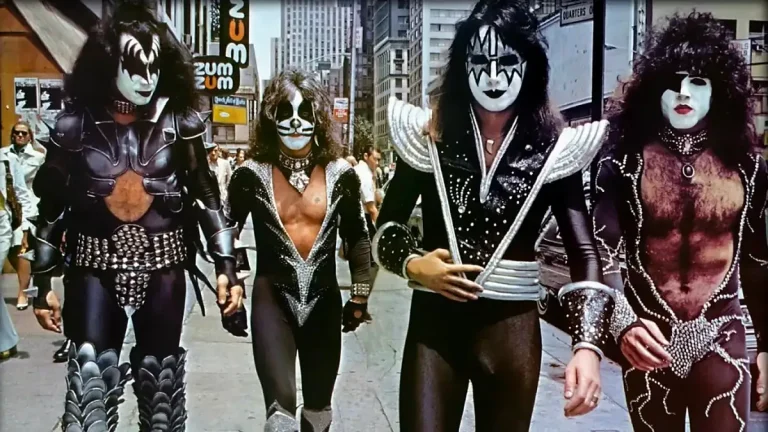
Paul Stanley (vocals and rhythm guitar). He wrote “I Want You” and “Hard Luck Woman,” and co-wrote “Mr. Speed” and “Makin’ Love” with Sean Delaney, also singing them. Without him the record would have neither its opening punch nor its most melodic jewel.
Gene Simmons (bass and vocals). He contributed “Calling Dr. Love” and “See You in Your Dreams,” and played rhythm guitar on “Ladies Room.” His bass holds up the floor of the whole record with a punch you can feel.
Ace Frehley (lead guitar). It is the first Kiss album without a single composition by him, but his solos and tone remain the record’s signature. Kramer singled out his work, along with Stanley’s, on the guitars of “Hard Luck Woman.”
Peter Criss (drums and vocals). The voice of “Hard Luck Woman,” he co-wrote “Baby Driver” and delivered powerful drums recorded, as the legend goes, from a bathroom. After “Beth,” here he confirmed that the Catman could sing too.
Eddie Kramer (producer). Almost a fifth member: he picked the theater, chased the live sound and sided with Criss so he could sing “Hard Luck Woman.”
Rock and Roll Over, a legacy that still sounds alive
The album reached No. 11 on the Billboard 200 and was certified platinum in January 1977. Fifty years later it remains the most honest portrait of Kiss at their peak: four guys in makeup, an empty theater and ten songs with no frills. If you enjoyed this record, it is worth continuing with Creatures of the Night, where the band would harden its sound again. And to keep discovering the albums that built the genre, visit The Rock Review.
More information: Rock and Roll Over on Wikipedia, Hard Luck Woman on Wikipedia and Kiss on Wikipedia.